



The Industrial Power of Traditional Flavor: Sarbio Tomato Paste and its Production Journey
The heart of Turkish cuisine beats in tomato paste, which adds color, consistency, and depth to our dishes. Today, consumers are looking for that intense, fragrant traditional tomato paste flavor they ate in their childhood, and they also expect this flavor to be produced in the most hygienic, modern conditions. Right at this point, Sarbio Tomato Paste, introduced to the market with the assurance of Sarbay Group, brings together the traditional understanding of flavor with global industrial standards.
So, what is the secret that makes a tomato paste not just a food ingredient but an indispensable part of kitchens? In this article, we discuss in detail Sarbio’s technical production processes from field to table, quality standards, and strong position in the market.
🌱 1. From Field to Factory: Choosing the Right Tomato and Raw Material Acceptance
The journey of high-quality tomato paste begins in the right field, not in the laboratory or factory. The main reason why Sarbio’s quality is sustainable is contract farming and meticulous raw material selection.
- Choosing the Right Variety: Paste tomatoes (industrial type) should have a high dry matter ratio (brix), be fleshy, have few seeds, and be dark red in color. Only the ripest tomatoes meeting these criteria are selected for Sarbio.
- Raw Material Acceptance and Quality Control: Tomatoes arriving at the factory are subjected to brix (density), acidity, and color tests in modern laboratories. No product that fails to meet the standards is included in the production line.
🏭 2. Technical Production Stages of Sarbio Tomato Paste
Sarbio uses the latest technology to preserve the nutritional value of tomatoes and ensure microbiological safety. Industrial tomato paste production consists of the following stages that must be managed meticulously:
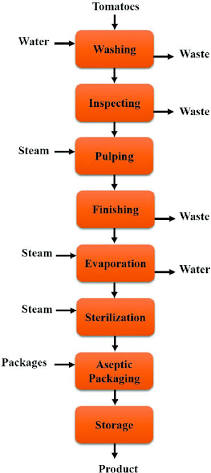
Industrial Tomato Paste Production Scheme.
- A. Washing and Sorting (Elimination): Tomatoes arriving at the factory are completely purified from dust, soil, and foreign materials in water channels and hydraulic flotation systems. Then, defective, green, or damaged tomatoes are eliminated by qualified personnel and optical sorters on the sorting belts.
- B. Crushing and Pre-Heating (Hot Break & Cold Break Technology): The sorted clean tomatoes are passed through crushers and turned into a slurry. The temperature applied at this stage determines the character of the paste:
- Hot Break (High Heating): As soon as the tomatoes are crushed, they are subjected to a temperature of 85°C – 95°C. With this method, pectin enzymes in the tomato are inactivated, ensuring the paste is thicker and more full-bodied. Sarbio owes that intense consistency sought in meals to this precise heat management.
- Cold Break (Low Heating): Heating is kept between 65°C – 75°C. More fluid but color-rich pastes are obtained.
- C. Passing Through the Pulper (Seed and Skin Separator): The heated tomato slurry is passed through high-speed sieve systems (pulpers and refiners). In this way, the skin and seeds of the tomato are completely separated, yielding a smooth, silky tomato puree (pulp).
- D. Evaporation (Concentration under Vacuum): The smooth puree obtained is boiled under a vacuum in multi-body evaporators. Thanks to the vacuum system, water evaporates at low temperatures (approximately 60°C – 65°C). If it were boiled at high temperatures, the sugar inside the tomato would burn (caramelize), the paste’s color would darken, and its nutritional values (especially Lycopene and Vitamin C) would be lost. Sarbio preserves its vibrant red color and nutritional value with vacuum technology.
- E. Pasteurization / Sterilization and Aseptic Filling: The paste, reaching the desired Brix value (usually 28% – 30% density), is sterilized at high temperatures to be purified from microorganisms. Immediately afterward, it is filled into aseptic bags, tin cans, or glass jars under sterile air conditions, without human touch. Thus, a long shelf life is achieved without the need for any preservative additives.
🌍 3. Marketing and Global Trade Power of Sarbio
Merely producing a brand with high quality is not enough; it must be supported by correct marketing strategies and a strong corporate structure. Sarbay Group Tomato Paste (Sarbio) has a strong vision in both the local and international markets.
- Sarbay Group Assurance: Sarbay Group’s deep-rooted experience in foreign trade, logistics, and the supply chain ensures that Sarbio reaches all over the world with the same freshness and speed. B2B (business-to-business) and B2C (business-to-consumer) processes in the market are managed professionally.
- Sustainability and Traceability: Modern consumers now want to know the source of the food they consume. Sarbio offers full “traceability” throughout the entire process from the field to packaging.
- International Certification: Sarbio production facilities are fully compliant with global standards such as ISO 22000 Food Safety Management System, HACCP, and Halal certificates. This puts the brand one step ahead in export markets.
⭐ Why Sarbio Tomato Paste? Outstanding Features
To summarize, the main features that distinguish Sarbio from its competitors and carry it to the top in kitchens are:
- High Lycopene Ratio: Since it is produced from naturally sun-ripened tomatoes, it is very rich in lycopene, a powerful antioxidant.
- No Artificial Additives or Colorants: It gets its color only from the tomato’s own pigments and its durability from advanced pasteurization technology.
- Ideal Consistency and Efficiency: Even if used in small amounts in meals, it provides intense flavor, ideal consistency, and perfect color thanks to its high brix ratio. It is economical.
- Strong Supply Network: Thanks to Sarbay Group’s logistical power, it offers uninterrupted and reliable supply opportunities from industrial kitchens to retail market chains.
Sarbio Tomato Paste blends modern technology with naturalness, appealing to both families looking for a homemade taste and professional chefs who do not want to compromise on standard quality. Sarbio is always by your side to bring the food vision of the future to your table today.
❓ 5. Frequently Asked Questions (FAQ) About Tomato Paste
Question 1: What does “Brix” mean in tomato paste, and what is Sarbio’s Brix value? Answer: Brix is the ratio of pure tomato dry matter (density) remaining after the water in the paste has been evaporated. The higher the Brix value, the denser and higher quality the paste. Sarbio Tomato Paste has a Brix value of 28% – 30%, which is considered the most ideal density in international standards, thus providing superior efficiency in meals.
Question 2: What is the difference between Hot Break (HB) and Cold Break (CB) paste? Answer: The difference is related to the initial heating temperature applied to the crushed tomato. In the Hot Break method, tomatoes are shocked at high heat (85°C-95°C); this preserves pectin enzymes, making the paste much denser, thicker, and full-bodied. This consistency is desired in sauces and pot dishes. Cold Break (65°C-75°C) is preferred for more fluid and fruity pastes. Sarbio is produced with Hot Break technology for ideal cooking performance.
Question 3: How does Sarbio Tomato Paste remain unspoiled for a long time even though it does not contain preservatives? Answer: The secret to Sarbio’s long shelf life is not chemical preservatives, but advanced pasteurization and aseptic filling technology. Immediately after the paste is completely sterilized at high temperatures, it is packaged untouched in sterile cabins with zero contact with the outside environment and air. As long as its packaging is unopened, it preserves its freshness and microbiological safety for years.
Question 4: Is Sarbio Tomato Paste suitable for industrial use? What are the packaging options? Answer: Yes, Sarbio is completely suitable for both retail and large-scale industrial use (catering, food factories, restaurants). While a 220 kg aseptic drum packaging option is offered for industrial production; lacquered tin can and glass jar alternatives in different weights are available for out-of-home consumption and retail channels.